


What an Iron Butterfly Spread Is
An iron butterfly spread is a four-leg options strategy that profits when the stock stays near one specific price at expiration. You sell an at-the-money straddle (one call and one put at the same strike) and buy protective wings (one out-of-the-money put below and one out-of-the-money call above). The result is a net credit — you collect cash to enter — with defined risk on both sides.
The iron butterfly spread is the credit version of the standard butterfly spread. Where a debit butterfly uses three legs of the same option type, the iron butterfly uses four legs with both calls and puts. The payoff at expiration is identical — same profit zone, same max loss zones, same tent-shaped diagram. The difference is structural: you collect a credit instead of paying a debit, and margin requirements replace capital outlay.
This guide covers the construction, the math, and the specific situations where the iron butterfly is the right choice over other neutral strategies.
How the Iron Butterfly Is Constructed
The four legs, all sharing the same expiration:
- Buy 1 OTM put at the lower strike (lower wing — defines downside risk)
- Sell 1 ATM put at the centre strike (short straddle leg)
- Sell 1 ATM call at the centre strike (short straddle leg)
- Buy 1 OTM call at the upper strike (upper wing — defines upside risk)
The centre strike is the same for both the short put and short call — this is the ATM straddle that generates most of the credit. The wings define your maximum risk and are equidistant from the centre.
Example: SPY at $550. Sell the $540/$550/$560 iron butterfly with 30 DTE.
- Buy 1 $540 put for $3.20
- Sell 1 $550 put for $7.80
- Sell 1 $550 call for $8.00
- Buy 1 $560 call for $3.40
Net credit: ($7.80 + $8.00) – ($3.20 + $3.40) = $9.20 ($920 per contract).
- Maximum profit: $9.20/share ($920 per contract) — occurs at $550 at expiration
- Maximum loss: $10.00 (wing width) – $9.20 (credit) = $0.80/share ($80 per contract)
- Lower breakeven: $550 – $9.20 = $540.80
- Upper breakeven: $550 + $9.20 = $559.20
- Reward-to-risk: $920 profit vs $80 risk = 11.5:1
That 11.5:1 reward-to-risk is deceptive. The probability of the stock finishing exactly at $550 is low. In practice, most iron butterflies are closed at 25-50% of maximum profit well before expiration — and those partial captures still produce excellent risk-adjusted returns because the credit received is large relative to the wing width.

Iron Butterfly Spread Payoff and Breakeven Math
The payoff diagram is the same tent shape as a debit butterfly:
- Below the lower wing ($540): Maximum loss. All options are in the money or offset each other. Loss = wing width minus credit received.
- Between lower wing and centre ($540 to $550): Profit increases linearly from the lower breakeven to maximum at the centre strike.
- At the centre strike ($550): Maximum profit. Both short options expire at the money with maximum time value eroded. You keep the full credit.
- Between centre and upper wing ($550 to $560): Profit decreases linearly from maximum to the upper breakeven.
- Above the upper wing ($560): Maximum loss. Same as below the lower wing.
Breakeven formulas:
- Lower breakeven = centre strike – credit received
- Upper breakeven = centre strike + credit received
Credit-to-width ratio: This is the key metric. Divide the credit by the wing width. In the example above: $9.20 / $10.00 = 92%. This means you collected 92% of the maximum possible value of the structure. The higher this ratio, the better — it means the breakevens are wide relative to the wing width. Ratios above 80% indicate a favourably priced iron butterfly. Below 60% means the structure is cheap (low IV environment) and the risk-reward is less attractive.
The CBOE options specifications govern settlement mechanics — important for SPX iron butterflies, which settle in cash (European style) rather than through share delivery.
Iron Butterfly vs Debit Butterfly
This is the most common source of confusion. Both have identical payoff diagrams at expiration. The differences are structural:
Iron butterfly (credit):
- Four legs using both calls and puts
- Entered for a credit — you receive cash
- Maximum loss = wing width minus credit received
- Requires margin (the short straddle creates a margin obligation)
- Early assignment risk on the short put and short call legs
Debit butterfly:
- Three legs using all calls (or all puts)
- Entered for a debit — you pay cash
- Maximum loss = debit paid
- No margin required (the debit is your full risk)
- No early assignment risk on the long legs
When to use which: Use the iron butterfly when you are selling the structure for a credit — it is more capital-efficient because the credit reduces your margin requirement. Use the debit butterfly when you want no margin obligation and the simplicity of three legs. On high-volume underlyings like SPY and SPX, check both — whichever has tighter bid-ask spreads across all legs is the better execution.
Iron Butterfly vs Iron Condor
Both are four-leg, defined-risk, credit strategies. The difference is profit zone shape:
Iron butterfly: Maximum profit at one price (the centre strike). Narrow peak, steep sides. Higher maximum credit for the same wing width. Best when you have a specific price target and expect the stock to pin near that price.
Iron condor: Maximum profit across a range of prices (between the two short strikes). Flat-topped profit zone, gentler sides. Lower maximum credit for the same wing width. Best when you expect the stock to stay within a range but do not have a specific target.
The practical trade-off: The iron butterfly collects more premium (60-90% of wing width vs 20-40% for a condor) but requires more precision. The iron condor gives you a wider margin of error but smaller maximum profit. If you think the stock will be “at $550,” use an iron butterfly. If you think it will be “somewhere between $540 and $560,” use a condor.
Hybrid approach: Some traders use the iron butterfly as a “wide iron condor” by splitting the centre strike — selling the 549/551 straddle instead of the 550/550 straddle. This creates a small flat zone at the centre and slightly widens the breakevens. In practice, the extra $2 of range is marginal — if you want a wider profit zone, just trade an iron condor.

When to Use an Iron Butterfly Spread
High IV environments. The iron butterfly’s credit increases with implied volatility because you are net short options (two short legs vs two long legs). When IV is at the 70th+ percentile, the credit-to-width ratio improves dramatically — you collect more credit relative to the wing width, which widens your breakevens and shrinks your maximum loss. Selling iron butterflies during high IV is the textbook application.
Pinning plays. Before or during options expiration, stocks sometimes pin near strikes with high open interest. An iron butterfly centred at the expected pin strike collects a large credit and profits from the pin. The credit structure means you receive cash upfront — if the stock pins, you keep most of it. If it doesn’t, your loss is limited to the wing width minus credit.
Post-event contraction. After earnings, Fed decisions, or other volatility events, IV contracts and the stock often settles into a narrow range. Selling an iron butterfly immediately after the event — when IV is still somewhat elevated but the direction is established — captures both the remaining IV contraction and the stock’s tendency to consolidate near the post-event price.
Income on indices. SPX and SPY iron butterflies are popular among income traders because the index options are highly liquid, have tight bid-ask spreads, and settle in cash (no assignment risk on SPX). The SPX options market structure makes execution efficient for multi-leg strategies.
Managing the Iron Butterfly After Entry
Take profit at 25-50% of maximum credit. On a $9.20 credit, close the position when you can buy it back for $4.60-$6.90 (capturing $2.30-$4.60 of profit). Do not hold for the full credit — that requires an exact pin at expiration. A 25% capture on a $920 credit is $230 of profit on $80 of risk. That is a 2.9:1 return on risk, achieved in days or weeks rather than holding to expiration.
Close early if the stock moves beyond a breakeven. If the stock drops below $540.80 or rises above $559.20, the position is in maximum loss territory. Close immediately — the loss cannot exceed the wing width minus credit, but there is no reason to hold a position that has reached its worst-case scenario hoping for a reversal.
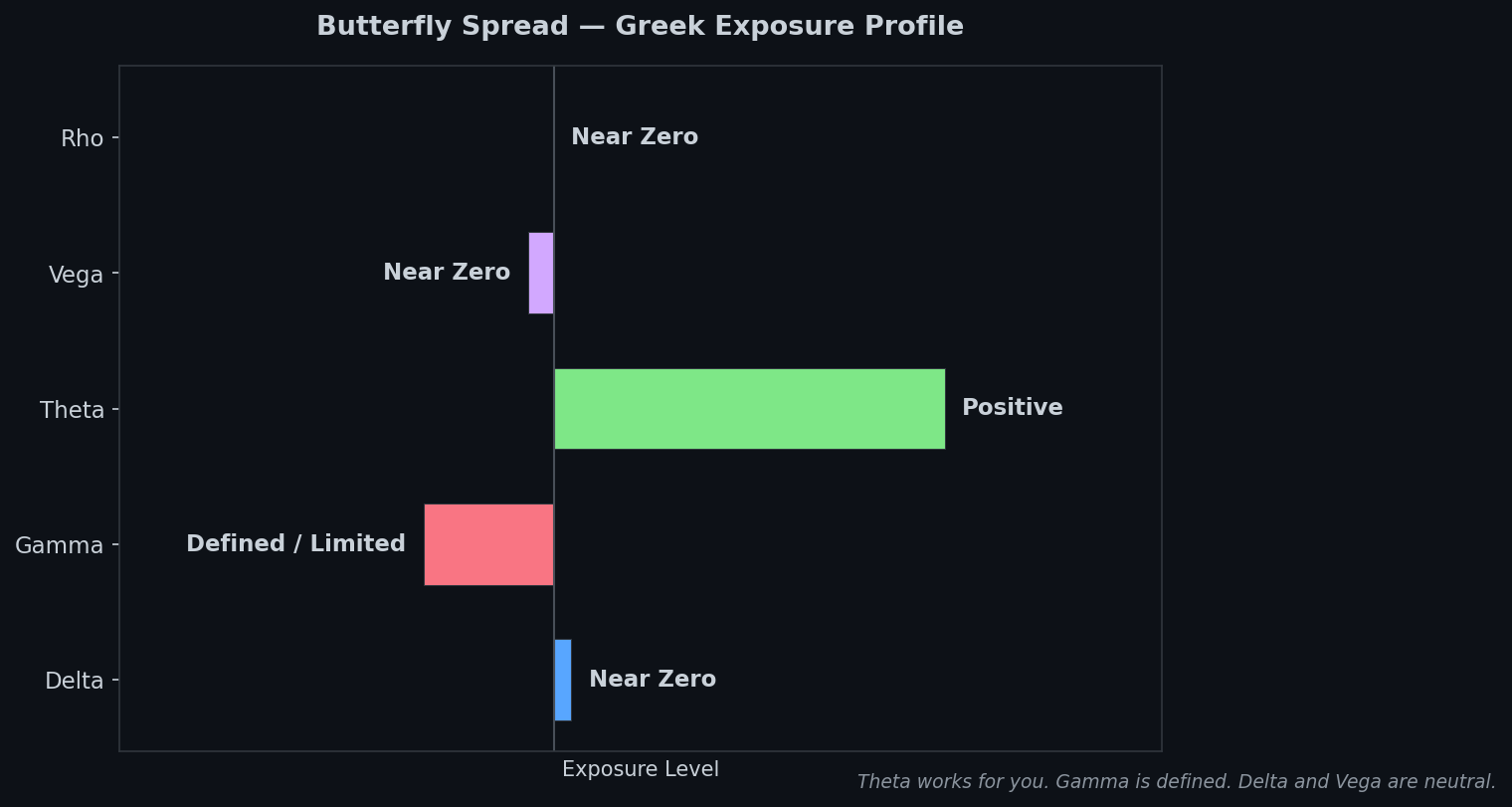
Time-based exit: close by 10-14 DTE. Gamma risk accelerates in the final two weeks. The iron butterfly’s large short straddle at the centre has significant gamma exposure — small stock moves cause large P&L swings. Taking profit or cutting losses before the final 10 days avoids the worst of this gamma whipsaw.
Do not leg out. Closing one side of the iron butterfly (e.g., buying back only the put spread side) converts the remaining side into a naked credit spread — a completely different risk profile. Always close all four legs simultaneously as a single order.
Example: ATM Iron Butterfly on SPY
SPY at $548, IV rank at 65th percentile (elevated after a 3% market pullback). You expect the market to consolidate near current levels over the next month.
Setup: Sell the $538/$548/$558 iron butterfly with 28 DTE.
- Buy 1 $538 put for $4.10
- Sell 1 $548 put for $8.70
- Sell 1 $548 call for $9.20
- Buy 1 $558 call for $4.50
Net credit: ($8.70 + $9.20) – ($4.10 + $4.50) = $9.30 ($930 per contract).
Risk parameters:
- Maximum profit: $930 at $548
- Maximum loss: $1,000 – $930 = $70
- Lower breakeven: $538.70
- Upper breakeven: $557.30
- Profit zone width: $18.60 (3.4% of SPY’s price)
- Profit target: close at 30% of credit ($279 profit, buy back for $651)
Scenario A — SPY at $550 after 14 days: The iron butterfly has decayed to approximately $6.50. Buy it back for $6.50. Net profit: $9.30 – $6.50 = $2.80/share ($280 per contract). Captured 30% of max credit in 14 days — target hit, close the trade.
Scenario B — SPY drops to $535 after 10 days: Below the lower breakeven. The position is at or near maximum loss. Buy back for approximately $9.80-$10.00. Net loss: $0.50-$0.70/share ($50-$70 per contract). The defined risk kept the loss small despite a $13 move against the position.
Scenario C — SPY at $548 after 21 days (near pin): The iron butterfly has decayed to approximately $4.00. Buy it back. Net profit: $5.30/share ($530 per contract). Captured 57% of max credit — well above the 30% target. Close and redeploy.
Frequently Asked Questions
Is an iron butterfly spread bullish or bearish?
Neither. The iron butterfly is a neutral strategy — it profits when the stock stays near the centre strike. There is no directional bias. If you want a directional butterfly, use a debit butterfly centred above (bullish) or below (bearish) the current price. The iron butterfly is designed for range-bound conditions where you expect the stock to sit still. The OCC options calculator can model how the P&L shifts as the stock moves in either direction.
How much margin does an iron butterfly require?
The margin requirement equals the wing width minus the credit received. On a $10-wide iron butterfly that collects $9.20 in credit, the margin is $0.80 per share ($80 per contract). This makes iron butterflies extremely capital-efficient — you control a $10-wide position for $80 of margin. The credit you received is held as collateral until the position is closed.
Can you get assigned on an iron butterfly?
Yes, on the short legs (the ATM put and ATM call). Early assignment is rare but possible, especially near ex-dividend dates on stocks. If assigned on the short put, you buy 100 shares at the centre strike. If assigned on the short call, you sell 100 shares short at the centre strike. In both cases, the long wing protects you — exercise it or close the remaining position. To avoid assignment risk entirely, trade SPX iron butterflies, which are European-style (no early exercise) and cash-settled.
What is the ideal IV environment for an iron butterfly?
High IV (50th percentile or above) is ideal. Higher IV inflates the credit you collect, which widens your breakevens and reduces your maximum loss. A $10-wide iron butterfly might collect $6.00 in low IV (narrow breakevens, $4.00 max loss) versus $9.00 in high IV (wide breakevens, $1.00 max loss). The same structure becomes dramatically more favourable as IV rises.
How does an iron butterfly spread differ from a short straddle?
A short straddle (sell ATM call + sell ATM put) has undefined risk — the stock can move infinitely in either direction, and your loss grows with every dollar of movement. The iron butterfly adds long wings that cap your risk at a defined amount. You sacrifice some of the straddle’s credit to buy this protection. The iron butterfly is the defined-risk version of the short straddle — same core thesis (stock stays near the strike), but with a maximum loss ceiling.
FATTAIL BRIEFINGS
Get FatTail briefings in your inbox
Pick the lists you want. FOMC Alerts is selected by default.