


What Delta Tells You About an Option
Delta is the option greek that measures how much an option’s price moves when the underlying stock moves $1. A call with 0.40 delta gains roughly $0.40 when the stock rises $1 and loses $0.40 when the stock falls $1. A put with -0.40 delta gains $0.40 when the stock drops $1. That is the textbook definition — and it is the least useful thing delta tells you.
The delta option greek does three jobs at once. It measures price sensitivity (how much the option moves), it approximates probability (the chance the option finishes in the money), and it represents your equivalent stock exposure (how many shares the option behaves like). Understanding all three uses is what separates traders who pick strikes deliberately from those who guess.
This guide covers the mechanics of the delta option greek, how it changes as conditions shift, and how to use it for strike selection, position sizing, and portfolio-level risk management.
Delta as Price Sensitivity
The primary definition: delta measures the rate of change in the option’s price relative to a $1 change in the underlying. It is expressed as a decimal between 0 and 1 for calls, and 0 and -1 for puts.
- Deep ITM call (delta 0.90): Moves $0.90 for every $1 move in the stock. Behaves almost like owning shares.
- ATM call (delta ~0.50): Moves $0.50 for every $1 stock move. The most sensitive to changes in other greeks.
- Far OTM call (delta 0.10): Moves $0.10 for every $1 stock move. Cheap in dollar terms, low probability, high leverage.
- ATM put (delta ~-0.50): Gains $0.50 when the stock drops $1. Loses $0.50 when the stock rises $1.
- Deep ITM put (delta -0.90): Moves nearly dollar-for-dollar with the stock, in the opposite direction.
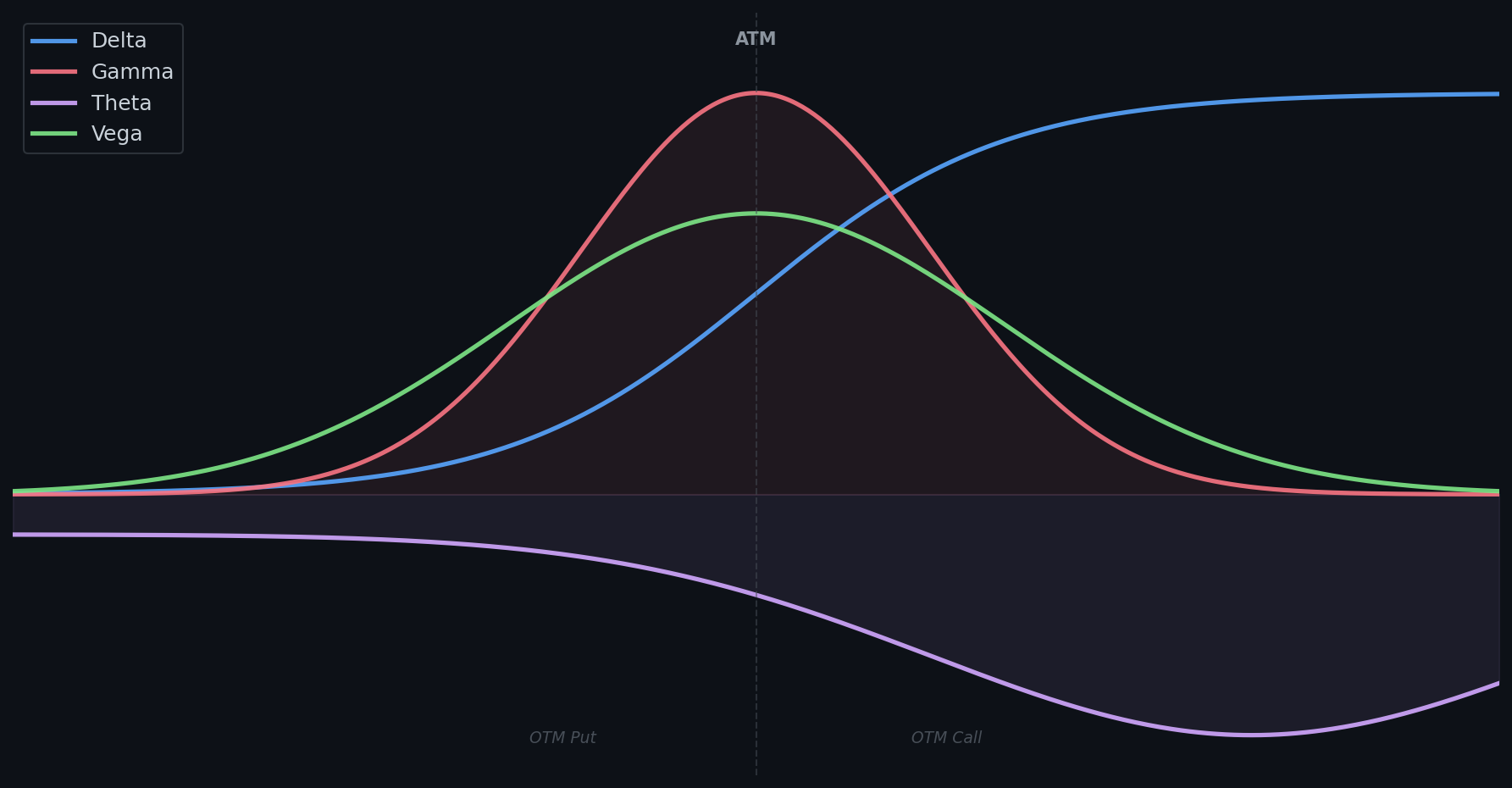
Delta is not constant. It changes as the stock moves, as time passes, and as implied volatility shifts. The rate at which delta changes is measured by gamma — the second-order greek that makes delta a moving target rather than a fixed number.
Delta as Probability of Expiring ITM
Delta approximates the market’s implied probability that the option will finish in the money at expiration. A 0.30 delta call implies roughly a 30% probability of expiring ITM. A -0.70 delta put implies roughly a 70% probability of expiring ITM.
This approximation works because option pricing models (Black-Scholes and its descendants) calculate delta using the same cumulative normal distribution function that produces probability estimates. The math is not identical — delta is a risk-neutral probability, not a real-world probability — but for practical strike selection the difference is small enough to ignore.
How traders use this:
- Covered call sellers use delta to choose their strike. A 30-delta call has roughly a 30% chance of being assigned — meaning you keep your shares 70% of the time.
- Credit spread sellers use the short strike’s delta to gauge the probability the spread finishes worthless. Selling a 10-delta put spread means roughly 90% probability of full profit.
- Directional buyers use delta to select risk-reward. A 0.50 delta call costs more but has a 50% chance of paying off. A 0.15 delta call is cheap but only pays off 15% of the time.
The probability approximation breaks down at extremes. Very deep ITM options can have deltas above 0.95 but still face rare gap risk. Very far OTM options with deltas below 0.05 are often mispriced due to skew and tail risk — their real probability of expiring ITM may be higher or lower than the delta suggests.
Delta as Equivalent Share Exposure
The third use of the delta option greek is portfolio-level exposure measurement. One call contract with 0.40 delta controls 100 shares, so the position behaves like owning 40 shares of stock (0.40 x 100 = 40 delta-equivalent shares). This is the “delta-equivalent” or “delta-adjusted” position size.
Example: You own 5 contracts of a 0.60 delta call on AAPL. Your delta exposure is 5 x 100 x 0.60 = 300 shares equivalent. A $1 move in AAPL changes your position by $300 — the same P&L impact as owning 300 shares of AAPL stock.
Portfolio managers use delta-equivalent exposure to answer a simple question: “How much am I really exposed to this stock?” A portfolio holding a mix of calls, puts, and shares can be summed into a single net delta number that describes total directional exposure.
Delta-neutral portfolios: When total portfolio delta equals zero, the portfolio has no directional exposure — it does not care which way the stock moves. Market makers maintain delta-neutral positions by hedging their options inventory with stock. Income traders running iron condors or iron butterflies start near delta-neutral because the long and short legs roughly offset.
How Delta Changes: The Key Relationships
Delta is not static. Four factors drive how the delta option greek shifts during a trade:
Stock price movement (gamma effect)
When the stock moves toward a call’s strike, the call’s delta increases. When it moves away, delta decreases. This is gamma at work — gamma measures the rate of delta change per $1 move in the underlying. ATM options have the highest gamma; deep ITM and far OTM options have low gamma because their deltas are already near their extremes (1.0 or 0).
This matters for trade management. A 0.30 delta call that moves ITM does not stay at 0.30 — it accelerates toward 0.50, then 0.70, then 0.90 as the stock keeps rising. Your exposure grows with the move. Conversely, if the stock drops, the call’s delta falls toward 0.15, then 0.05 — your exposure shrinks as the trade goes against you. This asymmetry is the built-in advantage of long options: you gain exposure as the trade works and lose exposure as it fails.
Time to expiration (charm effect)
As time passes, OTM options see their delta decay toward zero — the market assigns less probability to a far-out move happening with fewer days remaining. ITM options see their delta increase toward 1.0 as expiration approaches, because the chance of the option staying in the money rises when there is less time for a reversal.
ATM options maintain approximately 0.50 delta regardless of time remaining. But the rate at which delta changes around the ATM strike (gamma) increases dramatically near expiration — this is why expiration week produces violent P&L swings on ATM positions.
Implied volatility changes
Higher IV widens the probability distribution — the market expects a larger range of possible outcomes. This pushes OTM deltas higher (more probability of reaching the strike) and ITM deltas lower (more probability of the stock reversing). The effect is most visible during earnings or other high-IV events: far OTM options have noticeably higher deltas than they would in a low-IV environment.
When IV crushes after earnings, OTM deltas drop sharply even if the stock does not move. Your 0.20 delta call might become a 0.10 delta call purely from the IV contraction — the market no longer assigns the same probability to that strike being reached.
Interest rates and dividends
Higher interest rates slightly increase call deltas and decrease put deltas (because the forward price of the stock is higher). Upcoming dividends slightly decrease call deltas and increase put deltas (because the stock drops by the dividend amount on the ex-date). These effects are small for most retail trades but measurable on LEAPS and high-dividend stocks.
The Delta Option Greek in Common Strategies
Every options strategy has a delta profile that defines its directional bias:
- Covered call: Long 100 shares (+100 delta) plus short 1 call (-30 to -40 delta) = net +60 to +70 delta. Still bullish, but with reduced exposure compared to holding shares alone.
- Long straddle: Long 1 ATM call (+50 delta) plus long 1 ATM put (-50 delta) = net 0 delta. No directional bias at entry — profits from movement in either direction.
- Bull put spread: Net positive delta (short a higher-delta put, long a lower-delta put). Bullish with defined risk.
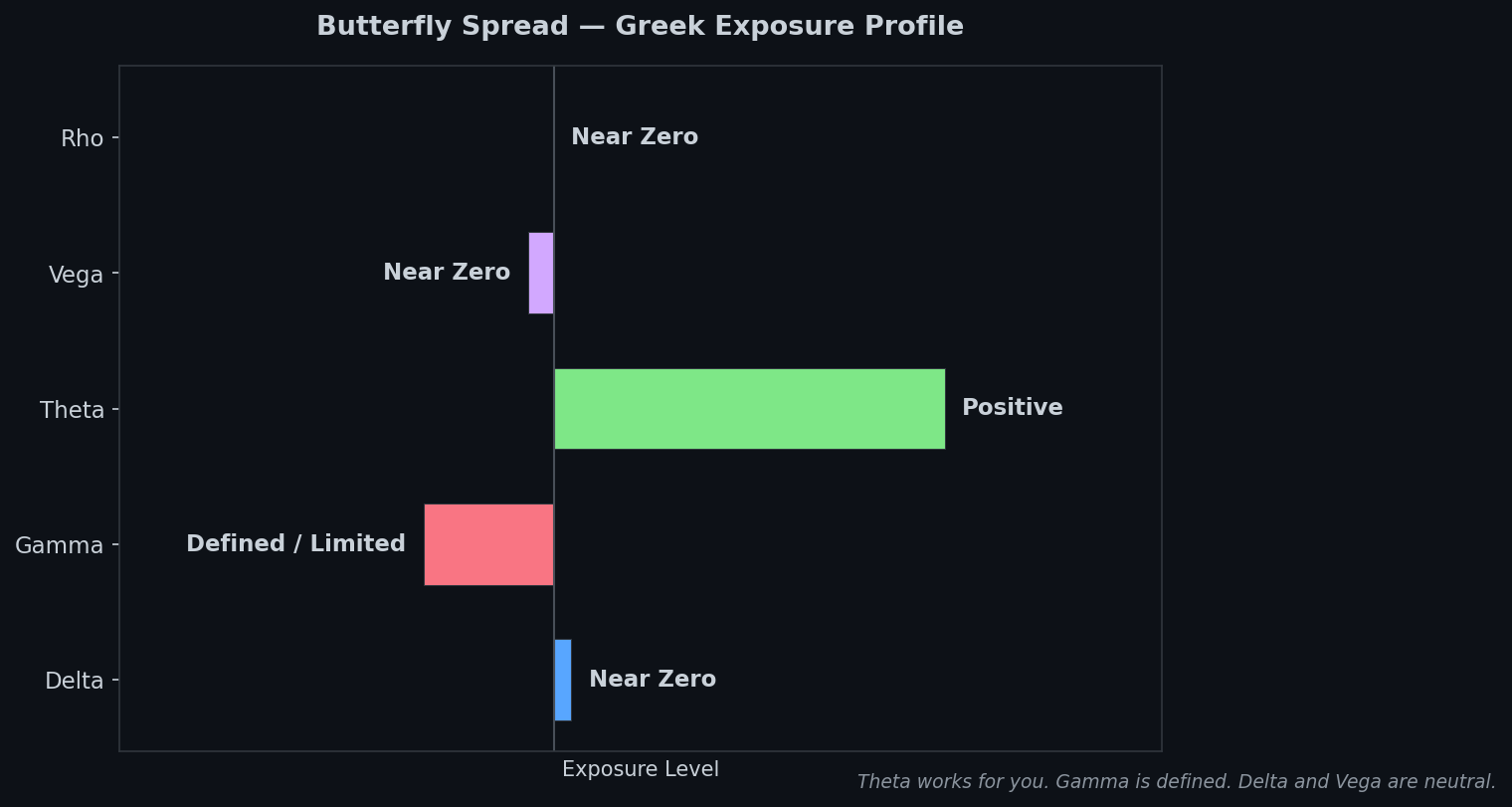
- Long butterfly: Near zero delta at entry. The long wings and short centre strike approximately offset. Profits from the stock staying near the centre, not from directional movement.
- Diagonal spread: Delta varies by strike and expiration selection. Typically small positive or negative delta depending on whether the long leg is a call (bullish) or put (bearish).
The practical takeaway: Before entering any multi-leg trade, check the net delta. It tells you your immediate directional exposure. If you intended a neutral trade but see +30 delta, you are actually bullish — and should either adjust or acknowledge the bias. The OCC options calculator displays delta for individual legs, making it straightforward to sum the portfolio exposure.
Using Delta for Strike Selection
The most practical application of the delta option greek is choosing which strike to trade. Instead of eyeballing the options chain and picking a strike based on price alone, delta gives you a framework based on probability and exposure:
Directional trades (buying calls or puts):
- 0.40-0.60 delta (ATM): Highest dollar sensitivity to the stock move. Best when you have a strong directional conviction and want maximum P&L per $1 of stock movement. Expensive, but highest absolute probability of profit.
- 0.20-0.35 delta (OTM): Lower cost, lower probability, higher percentage returns if the stock moves far enough. Best for defined-risk directional bets where you want leverage. Most debit spreads use a long leg in this range.
- 0.05-0.15 delta (far OTM): Lottery tickets. Very cheap, very unlikely to pay off. The math rarely favours buying options this far OTM because the time decay is severe relative to the probability of reaching the strike.
Income trades (selling options or spreads):
- Short 0.15-0.20 delta: The standard for credit spreads and covered calls. Roughly 80-85% probability of expiring worthless. The CBOE BuyWrite Index methodology uses a similar delta range for covered call benchmarks.
- Short 0.25-0.35 delta: More premium collected, lower probability of full profit. Used when IV is elevated and you want to maximise income per trade.
- Short 0.05-0.10 delta: Very high probability of profit but extremely thin premium. Transaction costs eat a larger percentage. Only practical on high-volume underlyings with tight spreads.

Delta and Position Sizing
Delta connects options position sizing to a dollar-based risk framework. Instead of counting contracts, think in delta-equivalent shares:
Example: Your maximum risk budget for a single stock is $500 per $1 move. You want to trade calls on a stock at $200.
- Option A: Buy 10 contracts of a 0.50 delta call. Delta exposure = 10 x 100 x 0.50 = 500 shares. A $1 move changes your P&L by $500. This fits your budget.
- Option B: Buy 20 contracts of a 0.25 delta call. Delta exposure = 20 x 100 x 0.25 = 500 shares. Same initial delta exposure, but these calls are cheaper per contract and have higher gamma — your delta will shift faster as the stock moves.
Both positions start with the same directional exposure. The difference is convexity — Option B has more gamma, so the delta-equivalent position grows faster if the stock moves in your favour and shrinks faster if it moves against you. That is more leverage, not more risk (your maximum loss is the premium paid).
Portfolio-level rule: Sum the delta-equivalent shares across all positions in a single underlying. If your combined delta on AAPL across all option positions is +800, you are exposed to AAPL as if you owned 800 shares — a $160,000 position at $200/share. Size accordingly.
Common Mistakes With Delta
Treating delta as fixed. New traders look at the delta at entry and assume it stays constant. It does not. A 0.30 delta call that goes ITM becomes a 0.60 delta call — your exposure doubled. Monitor delta throughout the trade, especially as the stock approaches your strike.
Ignoring delta on the short side. Selling a 0.10 delta option feels safe — 90% probability of profit. But when that option moves to 0.40 delta, your exposure has quadrupled. The net premium collected is fixed, but your risk has changed dramatically. This is why short option positions need active management.
Using delta alone for strike selection. Delta tells you the probability and exposure, but not the risk-reward. A 0.50 delta call might cost $8.00 and need a $8 move to break even. A 0.25 delta call might cost $3.00 and need a $12 move. Delta is one input — combine it with the breakeven distance, time to expiration, and IV level.
Confusing delta with edge. A 0.20 delta short put does not have an 80% chance of making money for free. The 20% of the time it loses, the loss is much larger than the premium collected. Delta measures probability, not expected value. The volatility skew further distorts this relationship because OTM puts are systematically more expensive than their delta-implied probability suggests.
Frequently Asked Questions
What is a good delta for buying call options?
For directional trades, 0.40-0.60 delta (ATM to slightly ITM) gives the best balance of cost and price sensitivity. You move nearly dollar-for-dollar with the stock without paying the full share price. For speculative trades where you want leverage, 0.20-0.30 delta provides cheaper entry with lower probability. Below 0.15 delta, time decay is aggressive and the probability of profit is low — these are lottery tickets, not trades.
Does delta change during the life of an option?
Yes, constantly. Delta changes when the stock moves (gamma), when time passes (charm), and when implied volatility shifts (vanna). ATM options maintain roughly 0.50 delta throughout, but OTM and ITM options see significant delta changes. A 0.30 delta call that moves into the money can become a 0.80 delta call. Monitor delta regularly, especially in the final two weeks before expiration when gamma accelerates changes.
Why do puts have negative delta?
Puts gain value when the stock declines, so their price moves in the opposite direction of the underlying. A -0.40 delta put gains $0.40 when the stock drops $1 and loses $0.40 when the stock rises $1. The negative sign indicates the inverse relationship. When calculating portfolio delta, the negative sign matters — a long put reduces your total directional exposure, which is why puts work as hedges.
How is delta different from gamma?
Delta measures how much the option price changes per $1 move in the stock. Gamma measures how much delta itself changes per $1 move. Delta is first-order sensitivity (speed); gamma is second-order (acceleration). A high-gamma option has rapidly changing delta, meaning your exposure shifts quickly as the stock moves. ATM options near expiration have the highest gamma — their delta flips between 0 and 1.0 with small stock movements, creating volatile P&L swings.
Can delta be greater than 1?
For a single standard option, delta is capped at 1.0 for calls and -1.0 for puts. Deep ITM options approach but never exceed these bounds. However, position delta (delta x number of contracts x 100) can be any number. Buying 5 contracts of a 0.80 delta call gives you 400 delta — equivalent to 400 shares. At the portfolio level, there is no cap on total delta exposure.
FATTAIL BRIEFINGS
Get FatTail briefings in your inbox
Pick the lists you want. FOMC Alerts is selected by default.