


FOMC Alerts · November 25, 2026
The Office of the United States Trade Representative today determined that the acts, policies, and practices of 14 economies relating to structural excess capacity in manufacturing are actionable under Section 301(b) of the Trade Act of 1974, and proposed additional tariffs for public comment. These are determinations plus proposed actions, not duties already in effect.
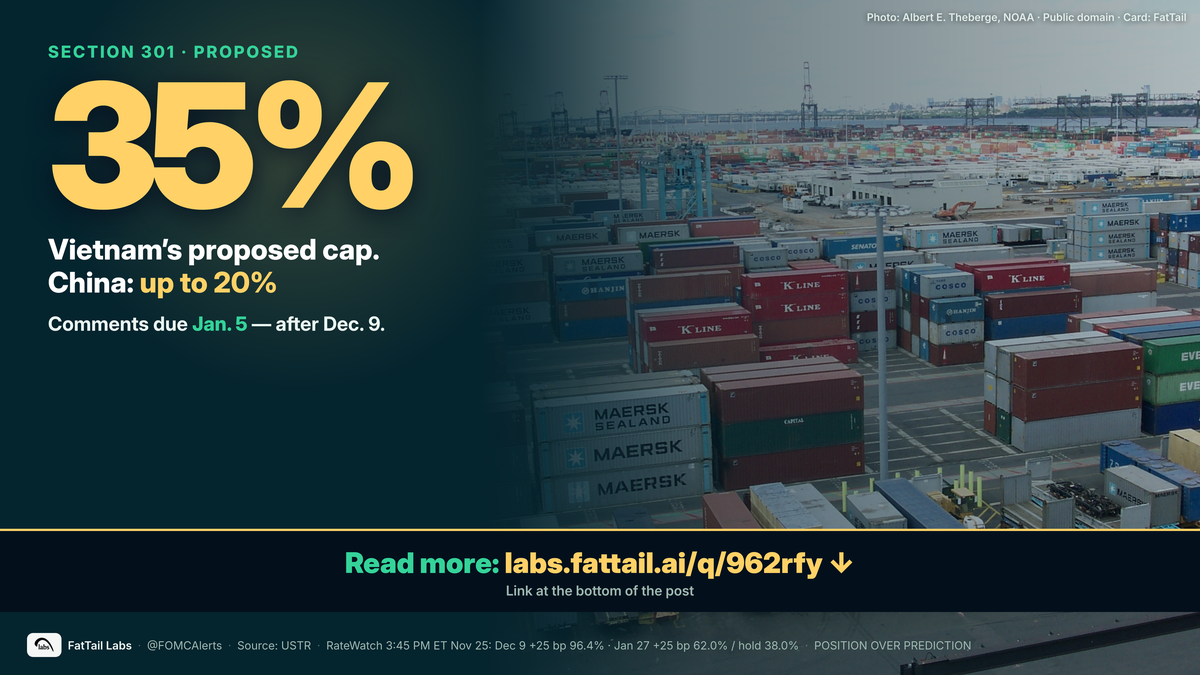
Section 301 tariffs China Vietnam: The headline proposed rates are up to 20% on goods of China and up to 35% on goods of Vietnam, or 20% if Vietnam reaches a responsive Agreement on Reciprocal Trade. Written comments and hearing requests are due January 5, 2027. Hearings begin January 25, 2027. Neither the press release nor the China and Vietnam Federal Register notices set an effective date, so the proposed duties will not be collected by the Dec. 8–9 FOMC.
This is the rates follow-up to our Nov. 24 preview, Section 301 Tariffs: The Dates Around the Fed’s Next Calls. Official October PCE was also published today — core 3.3% year over year, headline 3.8% — in October PCE 2026. We are not retelling either piece, and we are not writing that this proposal decides December.
Section 301 tariffs China Vietnam: the proposed rates
USTR self-initiated these excess-capacity investigations on March 11, 2026, covering 16 economies. Today it made determinations on 14: China, the European Union, Singapore, Switzerland, Indonesia, Malaysia, Cambodia, Thailand, Korea, Vietnam, Taiwan, Bangladesh, Japan, and India. Mexico and Norway were not determined.
On China, the pre-publication Federal Register notice proposes tariffs of up to 20%, net of the duty under the Section 301 forced-labor investigation (91 Fed. Reg. 47318, July 28, 2026), on goods not listed in the annexes; up to 10% on Annex A; and exemptions for Annex B, the U.S. Imports List of the U.S.–China Board of Trade “30-For-30” lists. An alternative of up to 40%, net of the same forced-labor duty, would apply to all goods of China if engagements inadequately address the issues. The 20% proposal accounts for the Kuala Lumpur Joint Arrangement rate of October 30, 2025. That is not a simple stack on every existing China levy, and the 40% alternative is not a blanket expiry of the Jan. 10, 2027 clock in our preview.
On Vietnam, the Federal Register notice proposes tariffs of up to 35%, net of existing Section 301 tariffs, on all goods of Vietnam, with listed exemptions, or 20% if Vietnam reaches a responsive Agreement on Reciprocal Trade.
In the Census Bureau’s FT900 for September 2026 (CB 26-178, Nov. 4; Exhibit 14, Census-basis goods, year-to-date through September), China was the fifth-largest country source of U.S. goods imports at $215.0 billion, or 7.8% of the total. Vietnam was sixth at $204.8 billion, or 7.4%. Vietnam’s $190.9 billion goods deficit was the largest country deficit on that exhibit.
What a proposal is, and what it is not
Section 301 lets USTR respond to foreign government practices it finds unjustifiable, unreasonable, or discriminatory and that burden U.S. commerce. Today’s step is a Section 301(b) determination plus a proposed remedial tariff, with a comment period and a hearing. A proposal is not a final proclamation and does not, by itself, change the duty paid at the border.
Some coverage treated the announcement as tariffs already being imposed, and one report dated the next FOMC as Dec. 9–10. The official 2026 calendar is December 8–9 (statement Dec. 9). Dec. 9–10 was the 2025 meeting.
Advertisement · From FatTail Labs

Observer: train with Coach for $17/week
A six-week trial and training program built to install pro trading habits: live daily coaching, courses, a Discord trade room and the full FatTail platform.
The dates around Dec. 8–9
The new fact relative to our tariff-calendar preview is the official rate schedule. The duties themselves remain in comment through January 5, 2027, with hearings beginning January 25 — after Dec. 8–9. The narrower Jan. 10, 2027 China suspension-and-extension clock, and the Dec. 4 polysilicon Section 232 action, remain separate instruments. We are not flattening the 40% alternative into a general truce expiry, and we are not retelling that calendar here.
The announcement is context for a Committee that already has official October PCE. It is not a reason to rewrite house odds or to say a December hike is more likely. For the path into January, see January 2027 Fed hike odds after October PCE and the RateWatch stamp below.
The 2025 tariff incidence finding, not a forecast
A February 2026 study by Mary Amiti, Chris Flanagan, Sebastian Heise, and David E. Weinstein, published by the Federal Reserve Bank of New York’s Liberty Street Economics, looked at the 2025 U.S. tariffs with import data through November 2025. “We find that nearly 90 percent of the tariffs’ economic burden fell on U.S. firms and consumers.” The authors put the share borne by U.S. importers at 94% in January–August, 92% in September–October, and 86% in November 2025. That is past incidence of those 2025 duties, not a forecast for today’s proposals.
Paul Donovan of UBS, quoted by Fortune, said: “The concern is the impact on U.S. inflation, and thus U.S. interest rates.” That line is reported here as Fortune printed it; we did not independently check it against a UBS note.
Dec. 9 and Jan. 27: where RateWatch stands
That is context, not a forecast, and not a claim that the announcement moved these odds. For the market’s path into the meeting, RateWatch, our fed funds futures (ZQ) method, as of 3:45 p.m. ET, Nov. 25:
- Dec. 9: +25 bp 96.4%.
- Jan. 27: +25 bp 62.0% / hold 38.0%.
- By Jan. 27 (cumulative): +50 bp total 59.8% (4.25–4.50%) / +25 bp total 38.9% (4.00–4.25%).
- Mar. 17: +25 bp 55.8% / hold 44.2%.
- By Mar. 17 (cumulative): +50 bp total 48.1% (4.25–4.50%) / +75 bp total 33.3% (4.50–4.75%) / +25 bp total 17.9% (4.00–4.25%).
- Two-meeting sequences: Dec 9 +25 bp then Jan 27 +25 bp 59.8%; Dec 9 +25 bp then Jan 27 hold 36.6%.
These are market-implied probabilities, not forecasts. The last official decision was the Oct. 28 hold at 3.75–4.00%, with Lisa D. Cook and Beth M. Hammack dissenting for a quarter-point hike, per the Oct. 28 statement. The Sept. 16 meeting had raised the target by 25 basis points, to 3.75–4.00%, with no dissents, per the Sept. 16 statement. Descriptive only. For the calendar, see the FOMC meeting schedule 2026 and our December Fed meeting 2026 preview.
What it means for 0DTE
- Energy: This is a trade-policy proposal whose comment period runs past the Dec. 8–9 FOMC. This brief has no measured same-day beta from the announcement to SPX or VIX, and we are not inventing one. It is context for the meeting, not a same-day catalyst.
- Premium: VIX 27.90 at 3:51 PM ET, versus Tuesday’s 26.36 close; SPX 7,188.99 (-0.17% vs. 7,201.09) at the same time (Massive). Timestamps only; we are not assigning a cause, and we are not attributing the afternoon tape to the USTR announcement or to PCE.
- Structure: Defined risk, max loss known before entry. Markets are closed Thursday for Thanksgiving and close at 1:00 p.m. ET Friday.
- Plan, don’t predict: Keep a January-hike plan and a January-hold plan. No direction call, and no claim that these proposals decide December.
Related reading: FOMC Alerts · FOMC meeting schedule 2026 · Economic reports tracker · Section 301 tariff calendar · October PCE 2026 · January 2027 Fed hike odds · December Fed meeting 2026 · Inflation drivers and Fed hikes
Sources
- USTR Makes Determinations and Proposes Actions in 14 Section 301 Investigations Relating to Structural Excess Capacity and Production in Manufacturing Sectors (Office of the United States Trade Representative, Nov 25, 2026)
- Notice of Determination and Request for Comments Concerning Proposed Action in the Section 301 Investigation of China Relating to Structural Excess Capacity (USTR, pre-publication Federal Register notice, Nov 25, 2026)
- Notice of Determination and Request for Comments Concerning Proposed Action in the Section 301 Investigation of Vietnam Relating to Structural Excess Capacity (USTR, pre-publication Federal Register notice, Nov 25, 2026)
- U.S. International Trade in Goods and Services, September 2026 (FT900) (U.S. Census Bureau and BEA (CB 26-178), Nov 4, 2026)
- Who Is Paying for the 2025 U.S. Tariffs? (Federal Reserve Bank of New York, Liberty Street Economics (Amiti, Flanagan, Heise, and Weinstein), Feb 12, 2026)
- FOMC meeting calendars (Board of Governors of the Federal Reserve System, 2026 calendar)
- Federal Reserve issues FOMC statement (Oct. 28, 2026) (Federal Reserve Board, Oct 28, 2026)
- Federal Reserve issues FOMC statement (Sept. 16, 2026) (Federal Reserve Board, Sept 16, 2026)
- White House tariffs announced on China, Vietnam, as inflation data comes back hot (Fortune (Eleanor Pringle); Donovan quote only, per Fortune, Nov 25, 2026)
Trade it with structure
Observer is a six-week trial and training program: train with Coach for $17/week. You get everything a full coaching member gets, every week, and the six weeks are designed to install pro trading habits: courses on strategy, process and risk management, live daily coaching, a Discord trade room with hundreds of experienced traders, and the platform (heatmap, GEX tools, risk graph, position analyzer and journal). Start Observer.
Educational content, not investment advice. Options involve risk and are not suitable for all investors.
FATTAIL BRIEFINGS
Get FatTail briefings in your inbox
Pick the lists you want. FOMC Alerts is selected by default.