


FOMC Alerts · October 26, 2026
Which central banks have raised rates in 2026?
Which central banks have raised rates in 2026? Of the ten big ones we track, eight. The Fed is one of them, and so are the ECB, the Bank of Japan, the Reserve Bank of India and the central banks of the Philippines, Korea, New Zealand and South Africa. Only the Bank of England and the Bank of Canada haven’t. Canada has sat at 2.25% at every 2026 decision (Bank of Canada); the Bank of England last moved with a cut in December 2025.
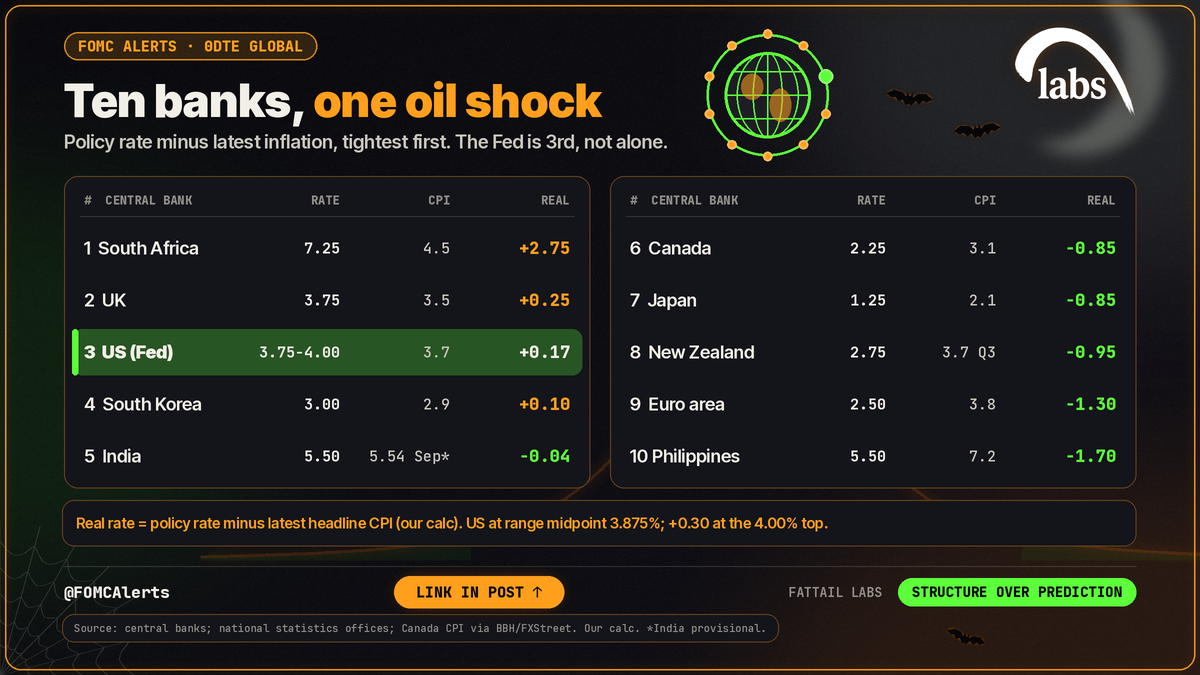
The common thread is the same oil shock showing up in everyone’s inflation numbers. So we put all ten on one scorecard: policy rate, latest inflation, and the gap between them. Subtract inflation from each policy rate and the US lands 3rd of 10. It’s on the tighter side of the pack, not out on its own. This is a map of where things stand, not a call on what anyone does next.
Last Thursday’s round: Manila went big, Seoul paused
Four central banks made news on Oct 21-22, and each one adds a piece to the picture.
- Philippines: Bangko Sentral ng Pilipinas raised its policy rate by half a point to 5.50%, its fourth hike in a row. Only 1 of 25 economists in Bloomberg’s survey saw 50bp coming; the other 24 expected a quarter point (Bloomberg via The Straits Times). September inflation ran at 7.2%, up from 6.1%, as reported by GMA News and Rappler, and the BSP raised its 2027 inflation forecast to 6.0% from 5.4%.
- South Korea: The Bank of Korea held at 3.00% by a 7-0 vote after hikes in July and August. September inflation was 2.9%, core 2.8%. The board didn’t close the door: it said it “will decide the timing and pace of further increases in the Base Rate” while it watches inflation, growth and financial stability (Bank of Korea).
- India: Minutes of the Reserve Bank of India’s Oct 5-7 meeting show the quarter-point hike to 5.50% passed 6-0. The 4-2 split was over the stance, the signal about what comes next, not the size of the move. The committee’s own resolution puts it plainly: “rate cuts are off the table in the near term and policy action ahead can only be a rate hike or a pause” (RBI minutes). India’s CPI rose to 5.54% in September (provisional), from 4.83% in August (MoSPI).
- Japan: The Bank of Japan’s own loan officer survey, taken Sep 9 to Oct 13, showed corporate loan demand edging up: its index rose to +3 from -1, and households to +5 from +3. It’s a modest pickup; 86% of the 50 banks saw firm demand as about the same (BoJ). The policy rate has been 1.25% since the Sep 18 hike, which passed 7-2, and that statement said the Bank will keep raising rates if its outlook plays out (BoJ, Sep 18). National inflation data out Oct 23 showed CPI up 2.1% from a year earlier in September, from 1.9% in August (Statistics Bureau of Japan).
Same shock, four inflation prints
Fuel turned up in nearly every inflation report this month. Where it shows up, and how hard, is uneven. For what oil is doing to US rate pricing, see how oil prices affect interest rates.
- New Zealand: Annual inflation was 3.7% in the September quarter, down from 4.1% but still above the 1-3% target band (Stats NZ). Petrol is the twist: up 19.1% from a year earlier, yet down 6.5% in the quarter. It was the biggest annual driver and the biggest drag on the quarter. The RBNZ has hiked twice this year, to 2.75%, and Reuters reported on Oct 21 that markets were pricing a hike at its next decision as near certain (Reuters via WTVB).
- UK: CPI jumped to 3.5% in September from 3.1%, with motor fuels up 29.8% from a year ago (ONS). The Bank of England held at 3.75% in September, but three of nine members voted to hike (Bank of England).
- South Africa: Inflation edged up to 4.5%, and transport alone added 1.5 percentage points (Stats SA). The Reserve Bank’s own forecast has it peaking at 5.7% in November, so the bigger jump is a projection, not a print yet.
- Euro area: One deposit rate, 2.50%, covers 21 very different inflation rates. The euro-area average was 3.8% in September, with energy up 18.9%, and member countries ranged from 2.4% in Malta to 6.1% in Lithuania (Eurostat). Twenty of the 21 run hotter than the ECB’s rate.
Advertisement · From FatTail Labs

Observer: train with Coach for $17/week
A six-week trial and training program built to install pro trading habits: live daily coaching, courses, a Discord trade room and the full FatTail platform.
Real interest rates by country: subtract inflation, then rank
A policy rate on its own doesn’t tell you how tight a central bank is. A 5.50% rate means one thing with 2% inflation and another with 7%. The rough fix is a real rate: the policy rate minus the latest headline inflation rate. Positive means the rate sits above inflation. Negative means it doesn’t, even after a hike. Here are all ten, tightest first (our calculation):
| Central bank | Policy rate | Last move | Latest CPI y/y | Real rate | Next decision |
|---|---|---|---|---|---|
| South Africa (SARB) | 7.25% | +25bp, Sep 23 | 4.5% (Sep) | +2.75 | Nov 19 |
| UK (BoE) | 3.75% | Held 6-3, Sep 17 | 3.5% (Sep) | +0.25 | Nov 5 |
| US (Fed) | 3.75-4.00% | +25bp, Sep 16 | 3.7% (Sep) | +0.17 | Oct 28, 2:00 PM ET |
| South Korea (BoK) | 3.00% | Held 7-0, Oct 22 | 2.9% (Sep) | +0.10 | Nov 26 |
| India (RBI) | 5.50% | +25bp, Oct 7 | 5.54% (Sep, prov.) | -0.04 | Dec 2-4 |
| Canada (BoC) | 2.25% | Held, Sep 2 | 3.1% (Sep) | -0.85 | Oct 28, 9:45 AM ET |
| Japan (BoJ) | 1.25% | +25bp, Sep 18 | 2.1% (Sep) | -0.85 | Oct 29-30 |
| New Zealand (RBNZ) | 2.75% | +25bp, Sep 2 | 3.7% (Q3) | -0.95 | Tue Oct 27, 9:00 PM ET |
| Euro area (ECB) | 2.50% | +25bp, Sep 16 | 3.8% (Sep) | -1.30 | Oct 29, 9:15 AM ET |
| Philippines (BSP) | 5.50% | +50bp, Oct 22 | 7.2% (Sep) | -1.70 | Dec 17 |
The US real rate uses the midpoint of the Fed’s range (3.875%) and September CPI from the BLS. Canada’s 3.1% is as reported by BBH via FXStreet. Rates and decision dates come from each central bank; inflation from each national statistics office.
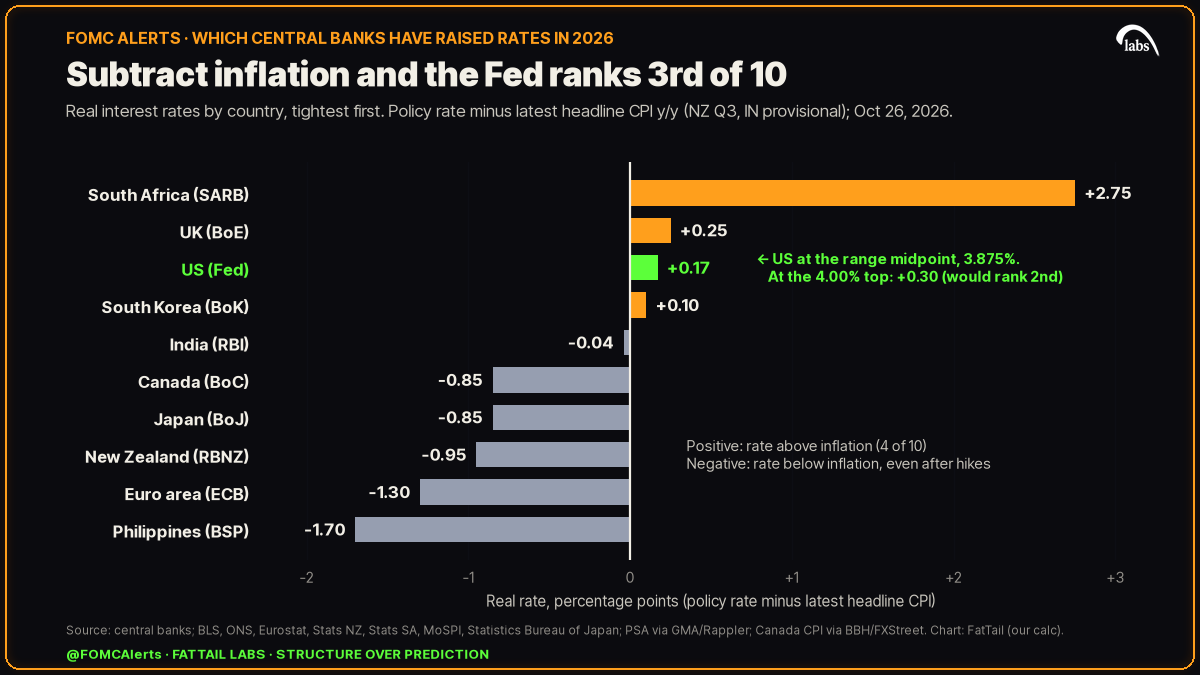
Three things jump out. Only four of the ten have a positive real rate: South Africa, the UK, the US and Korea. The median of the other nine is -0.85. And the hikers aren’t the tightest. The Philippines just went 50bp and still has the most negative real rate on the list, because its inflation is running at 7.2%.
So is the Fed the outlier?
Look at it three ways, and the answer is no each time.
- On real rates: 3rd of 10, at +0.17. Use the top of the range, 4.00%, and it’s +0.30, which edges past the UK into 2nd. Either way it’s near the top of the pack, and the ECB, the BoJ, the RBNZ and the BSP are all well below zero.
- On timing: The Fed’s Sep 16 hike, its first since July 2023, came after the ECB, the RBNZ, the BoK and the BSP had already started, and just before the BoJ (Sep 18), South Africa (Sep 23) and India (Oct 7). South Africa’s Reserve Bank listed the Fed alongside the ECB and the BoJ among the central banks raising rates in its own Sep 23 statement (SARB). Neither first nor last.
- On what’s priced: By our calculation from fed funds futures using CME’s method, in Monday’s overnight trading (Oct 26), an October hike was about 10%, and the chance of rates sitting above today’s range after the December meeting was about 81%. That second number is cumulative and includes October. On Oct 22, CME FedWatch had the December figure at 91%, also cumulative (Reuters). What else is priced for Fed week is in our Fed meeting this week preview. How those odds are built is in our guide to fed funds futures probability.
What the table shows is a Fed that has done roughly what its peers did, with inflation a bit lower than most of theirs. That’s a description of where it stands going into Oct 28, not a forecast of the vote.
What this table can’t tell you
- Headline, not core: The real rates use headline CPI, which carries the fuel spike. Core inflation would shift several rows, and the Fed’s own target is PCE inflation, not CPI.
- Different vintages: New Zealand is quarterly and India is provisional. A new print can move a row by more than the gaps between rows.
- Backward-looking: It subtracts the last inflation reading, not expected inflation. Central banks set policy on forecasts, so this is a snapshot, not a verdict on whether anyone is “behind the curve.”
- Different economies: A real rate of zero doesn’t bite the same way in Manila as in Frankfurt. Currency moves, debt levels and how fast rates feed through all differ.
Five decisions in about two days
- Tue Oct 27, 9:00 PM ET: Reserve Bank of New Zealand (2:00 PM Wednesday in Wellington).
- Wed Oct 28, 9:45 AM ET: Bank of Canada, with its Monetary Policy Report.
- Wed Oct 28, 2:00 PM ET: FOMC statement; Chair Warsh’s press conference at 2:30 PM ET.
- Thu Oct 29, 9:15 AM ET: ECB decision, with the press conference at 9:45 AM ET (ECB).
- Thu Oct 29, night ET: Bank of Japan, with its Outlook Report (Friday in Tokyo; the BoJ doesn’t fix a release time).
The full Fed calendar and everything we’ve written ahead of Oct 28 is on the FOMC Alerts hub.
What it means for 0DTE
- Event risk: For SPX, the scheduled event is the Fed at 2:00 PM ET on Wednesday. The RBNZ and the BoJ land outside US cash hours and the ECB 15 minutes before the open, so if they matter, they show up as a gap at the open, not a mid-session move. We have no data here showing how much any of them moves SPX.
- Premium: The VIX is calculated from SPX option prices. A global hiking backdrop doesn’t mean the event is already priced; check the VIX and the SPX expected move before each date.
- Structure: Keep risk defined and size for gaps on the days a foreign decision lands overnight.
- Plan, don’t predict: The Fed is in the pack, not alone. Plan for a hold and for a hike on Oct 28, and for the statement wording either way. Neither is a call.
When is the next FOMC meeting?
After Wednesday’s decision, the next FOMC meeting is Dec 8-9, with the statement and new projections on Wed Dec 9 at 2:00 PM ET.
Related reading
- Energy, Tariffs, Housing: What Fed Hikes Can Reach: the US side of the same oil shock, line by line.
- FOMC Meeting Schedule 2026: Fed Calendar Through December: every remaining Fed date this year.
- All FOMC Alerts posts: the full series, newest first.
Sources
- Philippines surprises with jumbo interest-rate hike as inflation surges, peso slumps (Bloomberg via The Straits Times, Oct 22, 2026)
- BSP hikes rates by 50 basis points (GMA News, Oct 22, 2026)
- Monetary Policy Decision (Oct 22, 2026) (Bank of Korea, Oct 22, 2026)
- Minutes of the Monetary Policy Committee Meeting, October 5 to 7, 2026 (Reserve Bank of India, Oct 21, 2026)
- Senior Loan Officer Opinion Survey on Bank Lending Practices (October 2026) (Bank of Japan, Oct 22, 2026)
- Annual inflation at 3.7 percent in September 2026 (Stats NZ, Oct 21, 2026)
- Consumer price inflation, UK: September 2026 (Office for National Statistics, Oct 21, 2026)
- Consumer Price Index, September 2026 (P0141) (Stats SA, Oct 21, 2026)
- Statement of the Monetary Policy Committee, September 2026 (South African Reserve Bank, Sep 23, 2026)
- Annual inflation up to 3.8% in the euro area (Eurostat, Oct 16, 2026)
- Key ECB interest rates (European Central Bank, accessed Oct 22, 2026)
- Policy interest rate (Bank of Canada, accessed Oct 22, 2026)
- Federal Reserve issues FOMC statement (Federal Reserve, Sep 16, 2026)
- Real Earnings, September 2026 (U.S. Bureau of Labor Statistics, Oct 2026)
- Consumer Price Index, Japan: September 2026 (national) (Statistics Bureau of Japan, Oct 23, 2026)
Trade it with structure
Observer is a six-week trial and training program: train with Coach for $17/week. You get everything a full coaching member gets, every week, and the six weeks are designed to install pro trading habits: courses on strategy, process and risk management, live daily coaching, a Discord trade room with hundreds of experienced traders, and the platform (heatmap, GEX tools, risk graph, position analyzer and journal). Start Observer.
Educational content, not investment advice. Options involve risk and are not suitable for all investors.